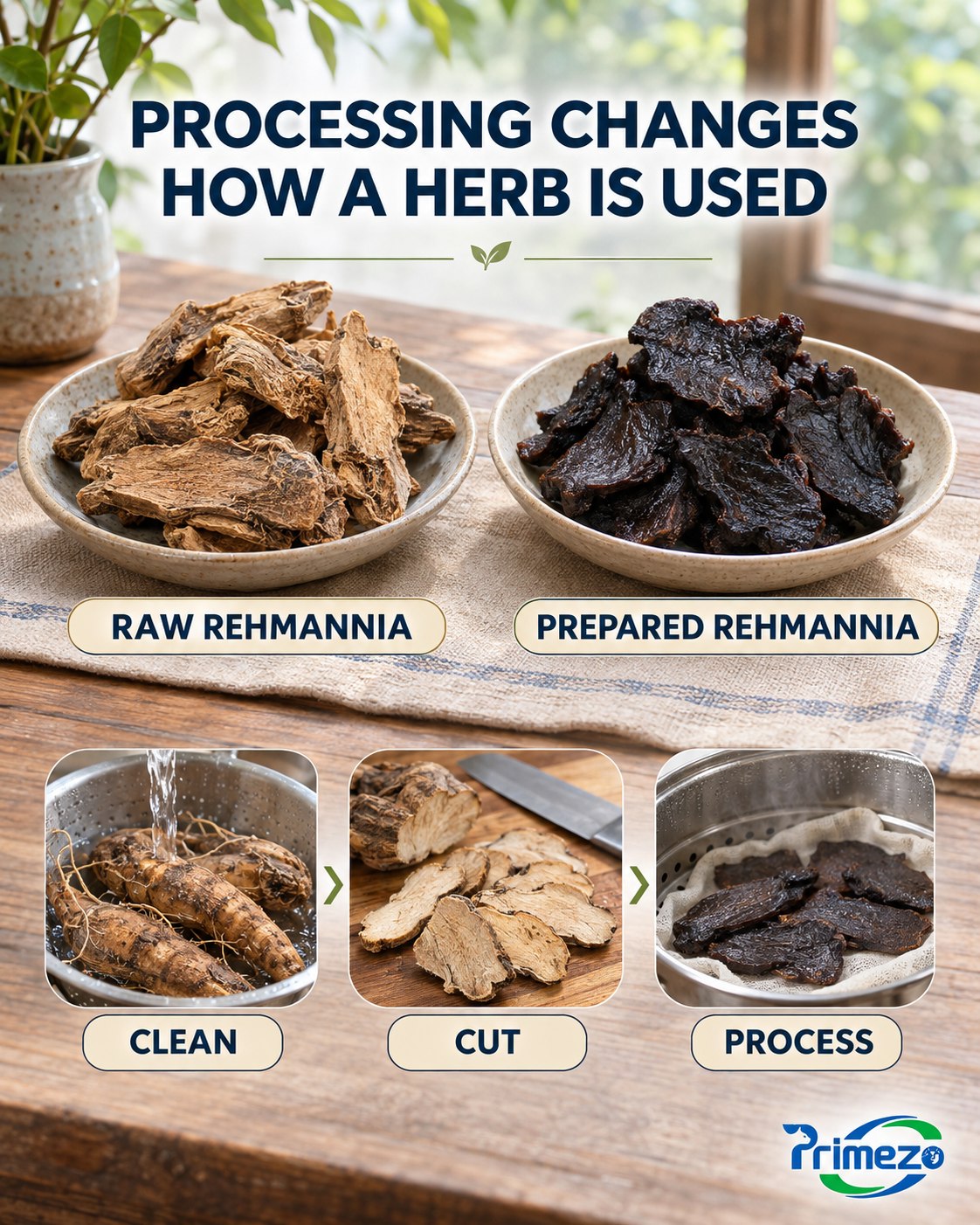
The same herb can point in a different TCVM direction after processing.
That is why Pao Zhi--炮制, Chinese herbal processing, is more than chopping and heating raw plants.
It is the controlled preparation of medicinal material according to its properties, the intended therapeutic direction and the requirements of formulation or storage.
The process can include three different levels.
Cleaning and selection remove soil, damaged material and non-medicinal parts so that the correct part of the herb is used.
Softening, cutting and drying create a defined form that can be weighed, extracted or incorporated into a formula more consistently.
Specialised processing may use heat, water or an approved processing medium. Depending on the herb, this can reduce toxicity or irritation, moderate its properties, change its TCVM functional direction, or make it more suitable for preparation and storage.
Rehmannia is a clear example.
Raw Rehmannia is traditionally used in a colder direction associated with clearing Heat, cooling the Blood and nourishing Yin. After steaming and preparation, it becomes Prepared Rehmannia, which TCVM uses in a warmer, Blood- and essence-nourishing direction.
The botanical source is related, but the medicinal identity is not interchangeable.
This matters when reading a formula or evaluating a product. Recording only “Rehmannia” is incomplete. The processed form—raw or prepared—helps determine what role that material can perform inside the formula.
Processing does not make every herb stronger. It makes the material more appropriate for a defined purpose.
For international TCVM communication, the important question is therefore not only “Which herb is present?” It is also: Which processed form is present, and why was that form selected?