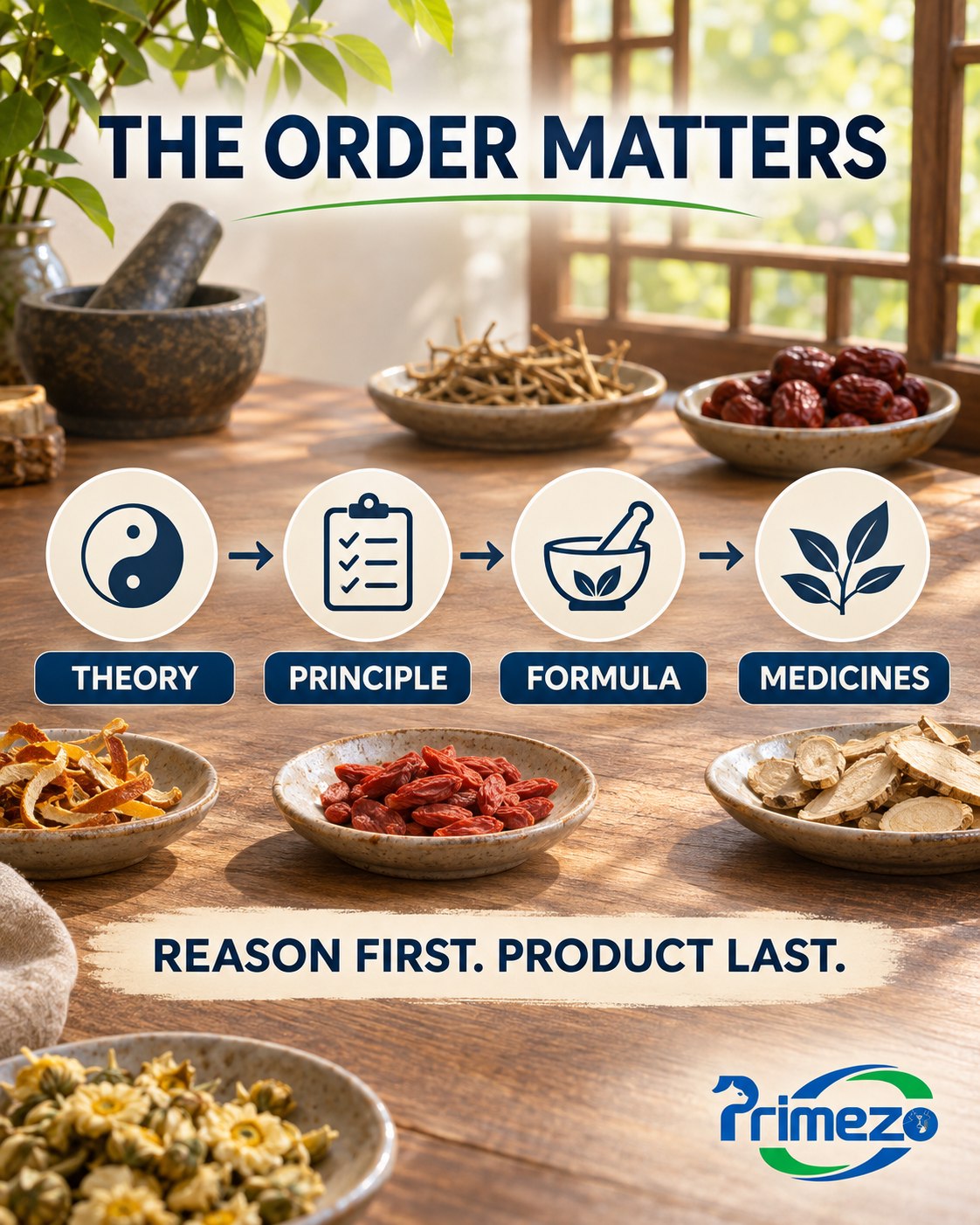
In TCVM, choosing the medicine before defining the pattern reverses the entire decision process.
The correct sequence is Li → Fa → Fang → Yao: understand the problem, establish the treatment principle, build the formula, and only then select the medicines.
Consider diarrhoea as a simple example.
Two animals may both have loose stools, but one may show a watery, cold pattern with poor appetite and weakness, while another may show foul-smelling diarrhoea together with Heat signs.
The symptom is the same. The TCVM reasoning is not.
Li 理 — the reasoning.
What is happening inside the functional system? Is this Cold-Damp, Damp-Heat, weakness of Spleen transformation, food stagnation or another pattern?
Fa 法 — the treatment principle.
Should the direction be to warm and transform Cold-Damp, clear Damp-Heat, strengthen the Spleen, or remove stagnation?
Fang 方 — the formula.
The formula is organised to carry out that principle. Its ingredients need defined primary and supporting roles rather than being collected because each one sounds useful.
Yao 药 — the medicines.
Only at this stage are the specific herbs, dose and dosage form selected to execute the formula.
If Li changes, Fa should change. When Fa changes, Fang and Yao should also change.
This is why a TCVM product cannot be explained well by a symptom list alone. A useful product explanation must show which pattern it addresses, what treatment principle it follows, and how its formula performs that task.
At Primezo, this is the order we use to translate TCVM formulas for international customers: reason first, product last.
Modern diagnosis and urgent care remain essential. Li–Fa–Fang–Yao is a TCVM reasoning framework, not a shortcut for diagnosing an animal from one visible symptom.