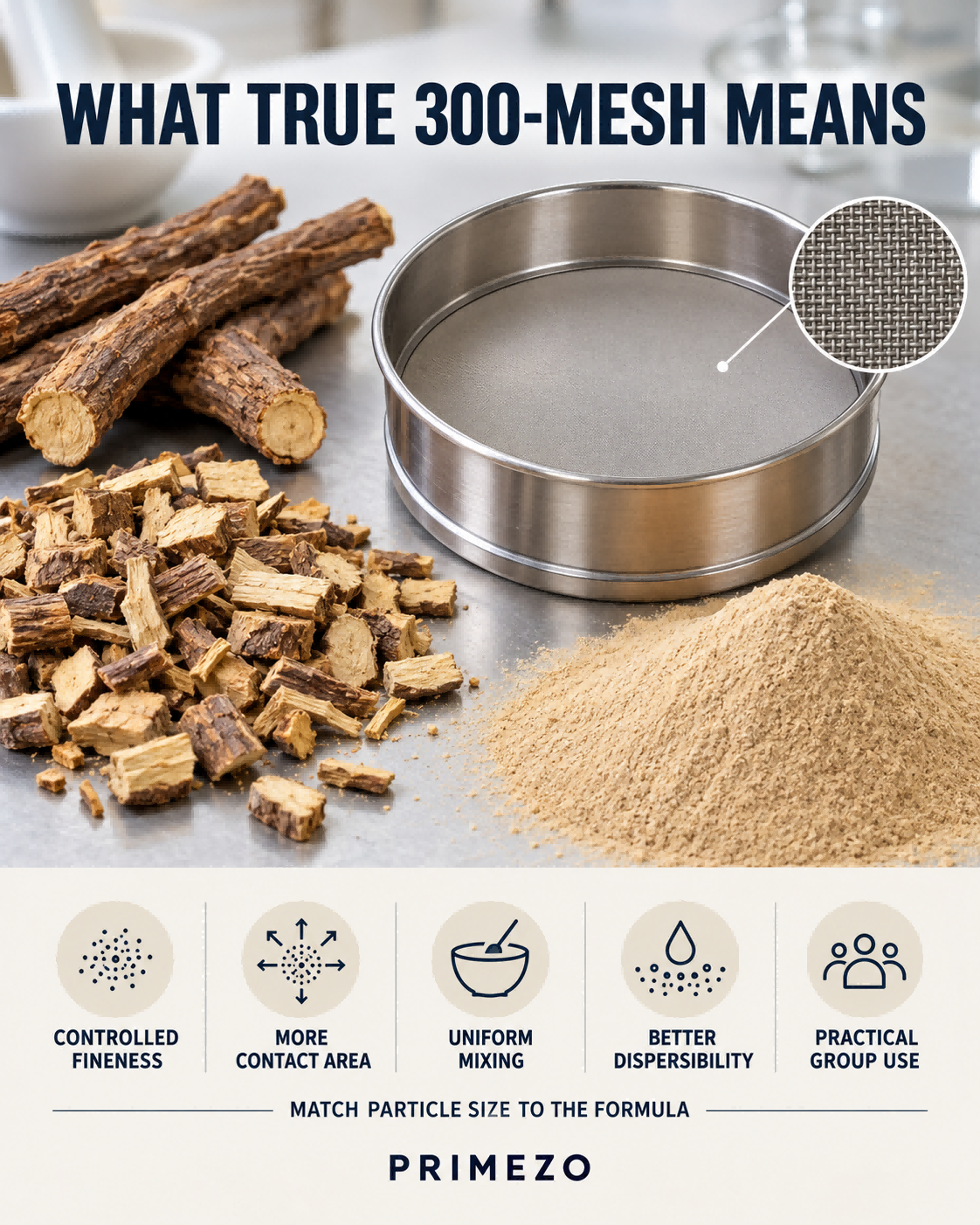
What does “300 mesh” actually mean in an ultrafine herbal powder?
For our 300-mesh products, at least 97% of the particles are smaller than 50 μm, with a cell-wall disruption rate of 85–90%.
That definition gives the mesh number a measurable meaning. It specifies:
- the particle-size limit;
- the proportion of particles meeting that limit; and
- the cell-wall disruption rate.
Our 300-mesh powders are designed for mixing into pelleted feed and mash feed. The purpose is not simply to make the herbs look finer. It is to produce a controlled powder suitable for even distribution through feed while retaining the formula’s original TCVM logic.
Our 500-mesh specification is different:
- 97% of particles are smaller than 30 μm;
- the cell-wall disruption rate is above 95%; and
- the powder is designed for drinking-water use.
This is why 300 mesh and 500 mesh should not be treated as a simple quality ranking. They are two particle specifications designed for different methods of administration: 300 mesh for feed, 500 mesh for water.
In our product range, PyroCleanse Powder, RespiraSoothe Powder and Liquorice Powder use 300-mesh processing for feed application. ImmuForte Powder is one of our 500-mesh products designed for drinking-water use.
TCVM determines the pattern and treatment principle behind a formula. Modern processing then determines how that formula can be prepared and delivered consistently in a herd or flock setting.
So when a herbal powder is described as 300 mesh or 500 mesh, four questions matter: How small are the particles? What proportion meets that size? What is the cell-wall disruption rate? Is it designed for feed or water?